

Different Contexts, Familiar Questions: Reflections from the China–Europe Philanthropy Exchange
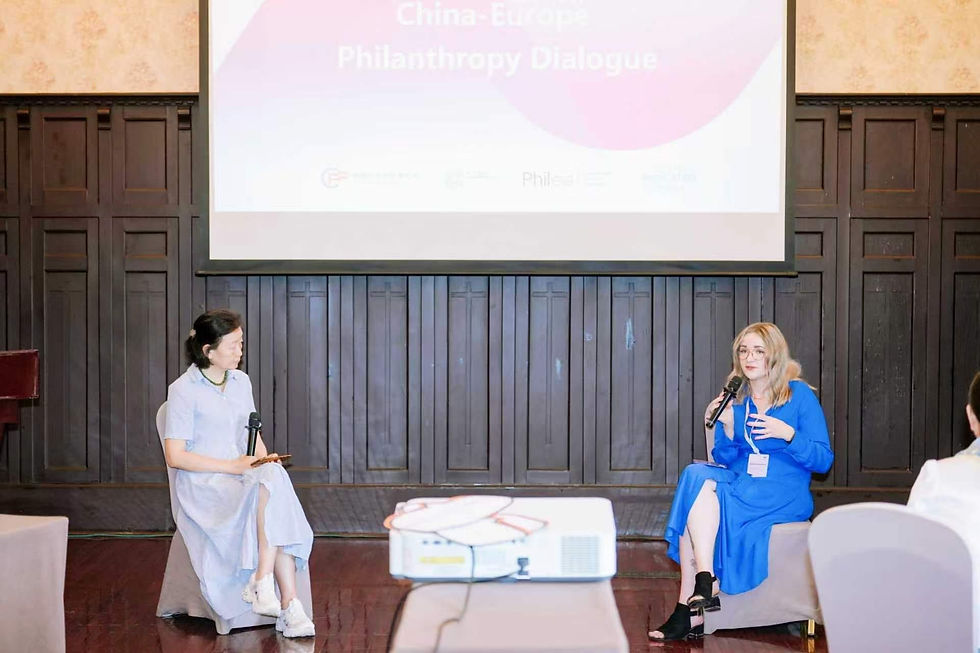
In September, I had the opportunity to attend the China-Europe Philanthropy Exchange Programme. The programme, organised by Philea, Stiftung Mercator and the China Foundation Forum, created a rare opportunity to step outside our own day-to-day work and spend a week immersed in another philanthropic culture. We heard from foundations, philanthropy infrastructure organisations, civil society organisations and corporate actors; explored systems and futures thinking; debated resilience, power and participation; and, importantly, had time for informal conversations about what philanthropy looks like in very different contexts.
I came home with plenty of practical ideas to bring into our work at Philanthropy Ireland, but also with some bigger questions about where philanthropy is heading.

Sometimes another ecosystem provides a mirror for your own
One of my strongest impressions from the week was not how different Irish and Chinese philanthropy are, but how familiar many of the underlying questions felt. Of course, the scale, history, legal structures and relationship with government are very different. China has experienced enormous growth in its foundation sector over the past two decades, while Ireland's institutional philanthropy ecosystem remains comparatively small.
But when conversations moved away from organisational structures and towards the development of the ecosystem itself, there was a surprising amount of common ground.
How do we move from reactive giving towards more strategic philanthropy?
How do we strengthen professional practice without losing the values and motivations that brought people into philanthropy in the first place?
How do we create stronger relationships between funders?
What infrastructure does a developing philanthropy sector need?
How do we build trust?
And what role should foundations play beyond simply transferring money?
One presentation on changes in Chinese grant-making framed the development of the ecosystem through three dimensions: money, relationships and culture. Money was about how capital flows and whether it is sustainable; relationships included funder-grantee dynamics, collaboration and engagement with government; and culture covered changing grant-making philosophies, definitions of success and the evolving role funders see themselves playing.
That felt remarkably close to some of the thinking behind Philanthropy Ireland's ecosystem work. We have been looking at the movement of capital, knowledge, collaboration and trust through the Irish philanthropy ecosystem. Different language and a very different context, but a similar recognition that a philanthropy ecosystem is about much more than the amount of money being given away.
That is perhaps one of the greatest values of an exchange like this. You do not necessarily come home wanting to replicate somebody else's model. Instead, seeing how another ecosystem has developed makes your own assumptions much more visible.
From funder to ecosystem builder
Another recurring trend across the week was an expanding understanding of the role of the funder.
One Chinese grant-making presentation showed funders identifying themselves in a range of roles: designer, financial sponsor, ecosystem builder, seeder, talent supporter, venture-style investor, research supporter and convenor. Interestingly, ecosystem builder was the role most funders wanted to add next. Collaboration also appeared to be much more established than might be assumed. In the research presented, 57% of surveyed funders were already involved in some form of co-funding, while information sharing and peer learning were even more common.
There is something important in that shift. If the role of a funder is understood only as selecting good organisations and funding good projects, then success is largely measured organisation by organisation and grant by grant.
An ecosystem-building mindset asks a different set of questions.
What is missing around the issue?
Who needs to be connected?
What knowledge or data needs to exist?
Where are organisations duplicating effort?
Is there enough talent in the field?
Are there organisations or relationships that everyone depends upon but nobody is funding?
It does not mean every foundation needs to become an infrastructure organisation. But it does suggest that good grant-making increasingly requires an understanding of the system around the grant. For us in Ireland, where the philanthropy ecosystem is still developing, there is an opportunity to build some of that connective infrastructure deliberately rather than waiting for it to emerge organically.
The corporate foundation question is more complicated than separation versus integration
Another area I am still thinking about is the role of corporate foundations.
A presentation from Fosun Foundation described a movement from traditional "check-writing" towards capability-based philanthropy. Rather than asking only how much money can we donate, the question becomes what problems can we help solve using the resources we already have? Those resources can include supply chains, R&D capability, technology, staff, customers, brands, networks and operational expertise. It is an attractive idea. Companies often have resources that could considerably amplify the impact of their philanthropic capital.
But other sessions surfaced the tensions that come with it: corporate accountability versus philanthropic independence and trust; strategic focus versus openness to emerging needs; visible measurable outputs versus slower systems change; foundation ownership versus partner autonomy. It brought me back to a question I raised immediately after the trip: is it better for a corporate foundation to remain very clearly separate from the company, or can greater social value be created when the strengths of both are intentionally intertwined?
I don't think I came home with a simple answer, and perhaps that is the point. Independence matters. A foundation needs credibility with partners and the ability to make decisions based on social need rather than commercial priorities. But complete separation may also mean ignoring expertise, relationships and capabilities within a company that could genuinely contribute to change.
Perhaps the more useful question is not separate or integrated? but how do we design the relationship intentionally enough to preserve the distinctive value of both?
That feels particularly timely as we continue to develop conversations around corporate philanthropy in Ireland.
Resilience is not just financial
Resilience and commitment sat at the heart of the exchange programme, and the conversations considerably expanded my understanding of both.
One presentation described the components of a healthier and more sustainable funding ecosystem as well-used resources, healthy relationships, collaborative gap-filling and clear, consistent roles. Another described financial resilience not as having more income, but as an organisational capability: diversified, adaptive, locally connected and impact driven.
The Chinese grant-making research also revealed an interesting gap in perceptions of patience. A large majority of funders described themselves as patient with their partners, but far fewer considered the wider funding sector to be patient. At the same time, there was growing attention to unrestricted funding, grassroots development and investment in talent.
There is a useful challenge here for philanthropy. We often talk about wanting resilient grantees. But organisations cannot simply be asked to become more resilient while operating within short funding cycles, restricted budgets and constantly changing priorities.
And resilience is not created when a crisis arrives.
It is created in advance through strong organisations, institutional memory, flexible resources and most importantly — relationships. That applies to philanthropy ecosystems too. A resilient ecosystem is not one where every actor is strong independently. It is one where actors know one another, can share information, fill gaps, adapt roles and mobilise collectively when circumstances change. Commitment is equally important. Staying with an issue over time does not mean refusing to change strategy. It means being able to adapt without losing sight of why you are there.
We need better ways of learning, not more information
Some of the most practical things I brought home were not presentations at all.
At IAC Berlin, we were gifted an ecosystem card game that turns systems thinking into something tangible and participatory. Instead of explaining ecosystems through another diagram, participants have to work through relationships, roles and changing conditions themselves.
A session with the adidas Foundation similarly used a stakeholder simulation to explore participatory grantmaking. Participants took on different roles; community member, grantee organisation, programme manager and board member and had to design a participatory and accountable decision-making process. A curveball was then introduced to pressure-test it before reflecting what had been protected, what had been compromised and where power had shifted.
What I liked about both approaches was that they made the tensions felt, rather than simply understood intellectually. We can talk about sharing power with communities. It is much harder when you have to decide what happens when participation slows a process down, when priorities conflict or when accountability to a board sits alongside accountability to the community.
That is something I am particularly keen to bring into our member learning at Philanthropy Ireland. In a sector dealing with complex questions, sometimes the most useful learning comes from creating a safe space in which people can test decisions, inhabit somebody else's position and explore the consequences.
Systems thinking needs futures thinking
The programme also gave considerable attention to systems and futures thinking, an area we have heavily invested our time and energy in over the last 12-18 months.
We worked with systems maps, systems timelines and the futures cone, moving away from the idea of predicting the future and towards considering a range of possible, plausible and preferable futures. That has obvious relevance to philanthropy. Grant-making can easily become shaped by what is urgent now: the current funding round, the current policy environment, the immediate needs presented by organisations.
Those things matter. But philanthropic capital can also afford to ask questions over longer horizons.
What is changing around the issue we care about?
What assumptions are we currently making that may no longer hold in five or ten years?
What capacities will organisations need?
What new actors may enter the system?
What would have to happen for a preferable future to become possible?
Systems thinking helps us understand how things are connected now. Futures thinking helps us consider how those connections might change. Combining the two creates a space between reacting to today's problems and pretending we can perfectly plan tomorrow's solutions.
AI will be a funding issue as much as a technology issue
Unsurprisingly, AI was another recurring theme, but the most interesting conversations were not really about the technology itself.
One session on AI in European Philanthropy highlighted four gaps: usage, organisational readiness, funding, and dialogue and equity. The striking point for me was the gap between foundations thinking about AI for themselves and helping the organisations they fund to navigate it. The data presented suggested that use is still more common for supportive functions than mission-related work; large proportions of both nonprofits and funders still lack organisational AI policies; 90% of foundation leaders surveyed reported providing no AI implementation support to grantees; and only 17% of nonprofit leaders said funders had engaged them in conversations about AI.
The conclusion was a useful one: philanthropy should connect mission, readiness, funding and equity, rather than treating AI as a stand-alone technology purchase.
That is an important trend to watch. If AI changes the cost of delivering services, the skills organisations need, how evidence is produced and how communities interact with services, then this cannot simply be a conversation for IT teams. Funders will need to think about the digital capacity of their partners, data governance, equity and the resources required for responsible adoption.

What exchanges can bring to philanthropy
Ultimately, I think the greatest value of the week was not discovering that somebody somewhere had already found the perfect model. It was almost the opposite.
Despite very different histories and institutional contexts, many of us were wrestling with remarkably similar tensions: independence and collaboration; patience and accountability; strategy and emergence; local knowledge and scale; funding organisations and funding ecosystems; embracing innovation while protecting trust.
International exchange is valuable because it gives us permission to interrogate practices that can become invisible when we see them every day. It also reminds us to be cautious about transplanting solutions. Something that works within the Chinese philanthropy ecosystem may rely on relationships between government, business and foundations that are very different in Ireland. Likewise, European approaches to civil society, regulation or philanthropic independence cannot simply be assumed to translate elsewhere.
The learning is in understanding why something works in its context and then asking what that tells us about our own. And, there was value beyond all of that in simply being immersed in another culture, having long conversations over meals, seeing organisations first-hand and stepping outside the normal rhythm of meetings, emails and deadlines. I returned with practical tools I want to share with our members, new perspectives on the ecosystem work we are developing at Philanthropy Ireland, and probably more questions than I left with. That feels like a very good outcome for an exchange programme.
A huge thank you again to Philea, Stiftung Mercator and the China Foundation Forum, to everyone who opened their organisations and shared their practice with us, and to the other participants who made the conversations around the formal programme every bit as valuable as the programme itself.
I also think I might like Karaoke now, but we won't mention that!


Comments