
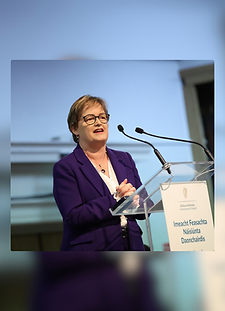
When we spoke with you in 2024, you described a vision of creating a culture in which philanthropy is better understood, its contribution is recognised and Government helps create the conditions for it to grow. More than two years into the Policy’s term, how would you assess progress towards that vision?
A key area of focus for us in the first two years of the Policy’s term has been on creating awareness of the value that philanthropy brings to Irish society. This was the vision behind holding our very first National Philanthropy Awareness Event in the RDS last May. It was hosted by Minister of State Jerry Buttimer and we were delighted that the Tánaiste, Simon Harris, was also able to join us on the day to give the opening address. The event brought together over 180 representatives from Government, local authorities, philanthropy, civil society and communities. Through keynote contributions, panel discussions and practical examples, it provided an opportunity to demonstratethe significant contribution philanthropy is already making across Ireland and, importantly, to explore how stronger collaboration can deliver greater public value. The feedback from the sector after the event was overwhelmingly positive. It felt like we started a movement, and we now need to keep the momentum going.
“It felt like we started a movement, and we now need to keep the momentum going."
The 2024 interview outlined plans for the five Policy sub-groups to develop work programmes and measures of progress, supported by annual implementation updates. What are the Policy objectives that have advanced, and where is greater momentum still needed?
We have established five sub-groups, as promised, each one in line with one of the key objectives of the policy. The sub-groups have been working hard on progressing the actions in their areas. For example, our Communications and Awareness Raising sub-group developed a Strategy which has led to the recruitment of a dedicated resource. Sinéad Dalton, Communications, Awareness and Strategy Lead at Philanthropy Ireland, leads national communications and engagement initiative supporting the National Policy on Philanthropy and strengthening collaboration between government, philanthropy and civil society.
The Capacity Building sub-group is working on the development of a comprehensive business case for a national capacity building programme to embed a culture of philanthropy across Ireland’s not-for-profit, community, cultural and sporting sectors. The Data and Research sub-group has commenced work on a consultation with Irish universities on the establishment of an academic centre for research on Philanthropy. Further information is available in the Annual Update reports which have been published for 2024 and 2025. The reports are available on the Department’s website.
You previously described the Policy as a framework for Government, philanthropy and beneficiaries to work more collaboratively and effectively. Has that ambition translated into new relationships, partnerships or ways of working? Are there examples you can share that demonstrate this change?
In June 2025, we launched a pilot place-based philanthropy funding call to test how collaboration between Government, local government, philanthropy and communities could support projects that address local needs. We were very pleased with the response, with more than 40 applications received, illustrating the interest in and potential for this kind of crosssectoral collaboration. Following a detailed assessment process, nine projects were approved for funding of €944,585, supported by philanthropic donations of nearly €1 million, resulting in a total investment of almost €1.9 million in collaborative projects. Many new relationships and partnerships have been forged in the development of the Framework for Collaboration, work arising from Action 17 of the Policy. This work has been ongoing between 2024 and 2026, under the auspices of the Government and Sectoral Partnership sub-group, drawing on:
national and international research,
practitioner experience from central and local government, philanthropists, and community groups, and
learning throughout the process via workshops and consultation.
Collaborating for Impact will be a suite of three complementary publications developed to strengthen public-philanthropic collaboration in Ireland. The publications will be launched later this year, followed by an open call for applications from the sector to test the framework.
“ ...there is a clear commitment from Government to continue to explore opportunities to progress this important objective of the policy. ”
A central ambition of the Policy is to create a more enabling environment for philanthropy and encourage more strategic giving, including by addressing regulatory, fiscal and other barriers. What progress has been made in this area, and where will further Government action be important?
Creating a more enabling environment for philanthropy and encouraging more strategic giving is very much a key focus of our work. The Stimulating and Incentivising Philanthropy sub-group and my team in the Department have been working closely together on this matter. We were delighted to have the Tánaiste and Minister for Finance, Simon Harris, address our National Philanthropy Event in May. In his Opening Address, he said:
“As Minister for Finance, I recognise the important role our tax system can play in supporting charities and encouraging philanthropy. I want to acknowledge the engagement that has already taken place with my Department on these matters and I can assure you that I will continue to work with Minister Buttimer to examine how we can continue supporting philanthropy and charitable giving into the future.”
As you can imagine, reforming the tax code in relation to philanthropy is a sensitive and complex process, and it will take time, but we are working very closely with our colleagues from the Department of Finance, as well as engaging with the Office of the Attorney General, to progress this work further.
While this work will take time, we can see from the Tánaiste’s words that there is a clear commitment from Government to continue to explore opportunities to progress this important objective of the policy.
What has Government learned through its closer engagement with philanthropic organisations and civil society during implementation? Has anything surprised you or changed your understanding of what is needed for effective Government– philanthropy collaboration?
During implementation, and even before that, while we were drafting the policy, the support of the sector has been incredible. I have been genuinely surprised and inspired by the willingness of all parties to get involved in supporting our work, their willingness to learn from each other and, more generally, their interest in the policy itself. The attendance at our National Philanthropy Awareness Event and our Framework for Collaboration Design workshops are two great examples of positive engagement by the sector. This is very validating and shows those of us working for Government that this policy is needed and that there is a real belief out there that the actions we are now delivering will benefit the sector. I also would like to acknowledge the role of key stakeholders and organisations, such as Philanthropy Ireland, in supporting our vision and undertaking trojan work to advance philanthropy in Ireland.
Policy implementation is rarely straightforward. Which aspects have proved more challenging or taken longer than anticipated, and what will be needed to overcome those challenges during the next phase?
The support we have received from the sector is fantastic, but I know that there is some frustration when it comes to timelines and what has been delivered so far. While we have made great progress on the implementation, I am also very conscious that we need to manage expectations. The actions of the policy are complex and often require detailed research, consultation, procurement processes, and much more to bring them to fruition. Implementation on the ground often requires multiple bodies to come together to deliver on the outcomes, and all of this takes time. However, that said, it is worth noting that we are making good progress on actions under all the five policy objectives, and we are only halfway through the lifetime of the policy.
Looking ahead to 2028, what are your priorities for the remaining period of the Policy, and what would successful implementation look like in practical terms for Government, the philanthropy sector and communities? On a personal level, what would you most like the Policy’s lasting legacy to be?
Our priorities for the remainder of the Policy term are no different from those we had identified at the outset – to raise awareness of philanthropy; to improve data and research; to identify and champion appropriate fiscal measures to stimulate philanthropy; to encourage cross-sectoral collaboration and to develop capacity in the sector. On a personal level, I hope that a legacy of this policy will be that more of my fellow civil and public servants will be aware of the huge potential that exists for collaboration between Government and philanthropy. During my own career as a civil servant, I have experienced first-hand how philanthropy can be a catalyst for significant policy change, and how much we can achieve by working collaboratively together.
“ ...I have experienced first-hand how philanthropy can be a catalyst for significant policy change, and how much we can achieve by working collaboratively together. ”
Finally, I would like to extend a sincere thank you to all the members of our Implementation and Monitoring Group, the members of the five subgroups, and the Chairs of the sub-groups. They have delivered a phenomenal amount of work, sharing their knowledge, expertise, and time with us. I am immensely grateful for their support and am looking forward to working with all of them as we continue to deliver on this key policy together.